
Intervista
Intervistatore:
Partiamo dal centro della questione. Tu dici che il Corano non incita alla violenza, ma allora come spieghi il versetto 9:5? “Uccidete gli idolatri ovunque li troviate.” Non mi pare un passo equivocabile.
Interlocutore:
Hai ragione: letto isolato, sembra una chiamata al massacro. Ma il Corano non è un trattato di teologia astratta; è un testo nato dentro la storia.
Il 9:5 venne rivelato dopo che alcune tribù avevano tradito i patti con Maometto. È, in termini moderni, una clausola di guerra contro chi aveva violato un accordo di pace.
Lo stesso passo successivo, il 9:6, ordina di proteggere chi chiede asilo, anche se non crede.
La durezza è contingente: l’Islam primitivo era una comunità assediata. L’immagine della spada nasce da quel contesto, non da un’ideologia di conquista globale.
Intervistatore:
Ma i versetti non parlano solo di guerra contingente. 8:12, ad esempio: “Colpiteli al collo e alle estremità.” O 47:4: “Quando incontrate i miscredenti, colpiteli.” Non è linguaggio spirituale. È violenza ritualizzata.
Interlocutore:
È linguaggio di battaglia, non di predicazione.
In 8:12, il soggetto sono gli angeli — non i credenti — nel racconto della battaglia di Badr. È la trasfigurazione epica di un episodio reale, come accade nell’Antico Testamento.
Il 47:4 stabilisce limiti: si combatte in guerra regolare e i prigionieri devono essere liberati per grazia o riscatto.
L’Islam codifica la guerra, ma la contiene. Dice: sì, combatti, ma secondo regole precise.
Intervistatore:
Eppure il Corano è pieno di “combattete”: 8:65, 9:123.
Se fosse davvero una religione di pace, non avrebbe bisogno di tanta energia bellica.
Interlocutore:
Il Corano è anche un documento politico.
La parola jihād significa “sforzo”, ma sì, i primi musulmani combatterono per sopravvivere.
Ogni religione nata sotto pressione ha dovuto legittimare la difesa.
La Bibbia non è meno aspra. Il problema non è il testo, ma come viene letto.
Intervistatore:
E che dire del versetto 3:85? “Chi desidera una religione diversa dall’Islam non sarà accettato da Dio.” È un’esclusione assoluta.
Interlocutore:
È un’esclusione teologica, non politica.
Il Corano ragiona in termini di verità ultima.
Sul piano umano, però, dice anche: “Non c’è costrizione nella religione”.
Intervistatore:
E il 3:28? “I credenti non prendano i miscredenti come alleati.”
Interlocutore:
Awliyāʾ significa protettori, patroni politici.
È prudenza, non odio.
Intervistatore:
E il 5:33? “Uccisi o crocifissi, o tagliati mani e piedi…”
Interlocutore:
È legge penale contro il ḥirāba: banditismo, terrorismo, violenza sociale.
Non riguarda l’infedeltà, ma il crimine.
E prevede il pentimento.
Intervistatore:
E il 9:30? “I giudei dicono che Ezra è figlio di Dio… Li annienti Allah!”
Interlocutore:
È polemica profetica.
Linguaggio duro, non istruzione militare.
Come nei profeti biblici.
Intervistatore:
Dunque ammetti che il Corano è anche un testo violento.
Interlocutore:
È un testo duale.
Spada e misericordia convivono, come nella storia umana.
L’errore è leggerlo come un manifesto ideologico unico.
Ci fu una pausa.
Poi spostai il discorso dove sapevo sarebbe diventato più fragile.
Intervistatore:
Quando la teoria incontra la vita, il punto sensibile resta sempre la donna.
È lì che la Sharīʿa diventa visibile.
Interlocutore:
Perché la famiglia è il centro dell’ordine sociale.
Intervistatore:
O perché è il luogo dove l’ordine si difende.
Sura 4:34 — “Gli uomini sono preposti alle donne.”
Sura 4:11 — eredità dimezzata.
Sura 2:282 — due testimonianze femminili per una maschile.
Qui la differenza diventa norma.
Interlocutore:
Diventa responsabilità.
L’uomo sostiene economicamente la famiglia, la donna è protetta da quel peso.
La giustizia non è uguaglianza matematica.
Intervistatore:
Ma oggi molte donne sostengono economicamente le famiglie.
Il contesto è cambiato.
Interlocutore:
L’interpretazione può adattarsi. Esiste l’ijtihād.
Intervistatore:
Può, ma raramente lo fa.
Quando si arriva alla donna, l’interpretazione rallenta.
Come se lì si difendesse qualcosa di più della legge.
Interlocutore:
La continuità della comunità.
Ogni civiltà teme di perdere se stessa.
Intervistatore:
E la donna porta quel peso simbolico.
Lui non negò. Rimase in silenzio per un momento.
Intervistatore:
E allora l’Islam è una religione di pace?
Interlocutore:
Dipende da cosa intendi per pace.
Non assenza di conflitto, ma ordine giusto.
Il Corano non chiede bontà: chiede giustizia.
E la giustizia, talvolta, ha un volto duro.
Intervistatore:
E la dottrina dell’abrogazione? Il cosiddetto “versetto della spada”?
Interlocutore:
È una tecnica giuridica, non un dogma.
Serve a gestire norme nate in condizioni storiche diverse.
Il fondamentalismo l’ha trasformata in ideologia.
Intervistatore:
Chi decide oggi cosa resta valido?
Interlocutore:
Nessuno da solo.
Il conflitto non è nel testo, ma tra le sue interpretazioni.
Poi, quasi alla fine, ho fatto un’ultima domanda.
Una di quelle che sembrano marginali, ma scavano più di tutte le altre.
«È vero o non è vero che nel Corano compare la parola Israele — e non compare mai la parola Palestina?»
L’imam rimase in silenzio per qualche secondo.
«È vero,» disse.
«Israele è un nome spirituale: un patriarca, una stirpe.
Palestina non serviva nominarla.
Dio non ragiona in confini, ma in obbedienze.
La terra appartiene a chi segue la Sua legge.»
Poi aggiunse, con una voce più bassa:
«Nel libro che doveva unire, Israele esiste. Palestina non è mai nata.»
Epilogo
Il dialogo è avvenuto con un colto imam della comunità islamica lombarda, alla presenza di una mediatrice culturale. Chi conosce l’Islam nella mia regione non ha difficoltà a darne un nome. Io non lo farò. Quanto avete letto è stato registrato. Vi era consenso. È durato poco.
Mi ero preparato. Avevo studiato i versetti, le interpretazioni, le obiezioni possibili. Sapevo dove volevo arrivare e, soprattutto, dove non intendevo andare.
Non era una conversazione esplorativa, ma un percorso tracciato in anticipo. Non ho mai abbandonato quel sentiero. Non perché mancassero le parole, ma perché non servivano. Il senso di quell’incontro non era convincere né essere convinto, ma misurare una distanza. Non colmarla. Non addolcirla. Non fingere che fosse più corta di quanto sia. Le posizioni erano chiare. Coerenti. Inconciliabili.
Non esco da quell’incontro persuaso che l’Islam sia una religione pacifica. Al contrario. È una religione totalizzante, in cui fede e legge coincidono, e in cui la pace non è libertà, ma ordine. Un ordine che discende dall’alto, non si negozia, non ammette dissenso strutturale. Per l’Occidente moderno, la pace nasce dal dubbio, dal conflitto regolato, dall’imperfezione accettata. Qui nasce dalla certezza. Non è una colpa. È distanza.
Nel diritto islamico classico, il rapporto con chi non condivide la fede non è fondato sull’idea di pace definitiva (salām), ma su quella di tregua (ḥudna): un accordo temporaneo, giuridico, rinnovabile, che sospende il conflitto senza risolverlo. Da una parte, l’idea occidentale di convivenza: stabilità costruita sul pluralismo, sulla permanenza del dissenso, sulla legittimità dell’altro. Una concepisce la pace come coesistenza stabile tra differenze permanenti. L’altra come tregua temporanea, fondata sull’attesa. Attesa che il numero diventi massa, che la massa diventi forza, e che la forza produca un mondo esclusivamente islamico.
Nel diritto islamico classico: la pace permanente con l’infedeltà organizzata non è l’orizzonte; l’orizzonte è l’ordine giusto (ʿadl), non la pace; la ḥudna è strumentale, non morale. Per questo: non si fa la guerra santa contro cristiani o altri soggetti durante la ḥudna; non perché siano riconosciuti come pari, ma perché esiste un accordo giuridico temporaneo.
Non pace. Nota bene. Tregua.
16 marzo
Interviewer:
Let us begin at the center of the matter. You say the Qur’an does not incite violence—yet how do you explain verse 9:5? “Kill the idolaters wherever you find them.” That does not seem open to interpretation.
Interlocutor:
You are right: read in isolation, it sounds like a call to slaughter. But the Qur’an is not a treatise of abstract theology; it is a text born within history.
Verse 9:5 was revealed after certain tribes had betrayed their pacts with Muhammad. In modern terms, it is a wartime clause against those who had violated a peace agreement.
The very next verse, 9:6, orders protection for anyone who seeks asylum—even if they do not believe.
The harshness is contingent: early Islam was a besieged community. The image of the sword emerges from that context, not from an ideology of global conquest.
Interviewer:
Yet the verses do not speak only of contingent war. 8:12, for instance: “Strike them upon the necks and strike from them every fingertip.” Or 47:4: “When you meet those who disbelieve, strike.” This is not spiritual language. It is ritualized violence.
Interlocutor:
It is the language of battle, not of preaching.
In 8:12, the subject is the angels—not the believers—in the account of the Battle of Badr. It is the epic transfiguration of a real episode, much like in the Old Testament.
Verse 47:4 establishes limits: one fights in a formal war, and prisoners must be released either by grace or ransom.
Islam codifies war, but it also contains it. It says: yes, fight—but according to precise rules.
Interviewer:
And yet the Qur’an is full of “fight”: 8:65, 9:123.
If it were truly a religion of peace, it would not require so much martial energy.
Interlocutor:
The Qur’an is also a political document.
The word jihād means “struggle,” but yes—the early Muslims fought to survive.
Every religion born under pressure has had to legitimize defense.
The Bible is no less harsh. The problem is not the text, but how it is read.
Interviewer:
And what of verse 3:85? “Whoever desires a religion other than Islam—it will never be accepted from him.” That is absolute exclusion.
Interlocutor:
It is a theological exclusion, not a political one.
The Qur’an reasons in terms of ultimate truth.
On the human level, however, it also says: “There is no compulsion in religion.”
Interviewer:
And 3:28? “Let not the believers take the disbelievers as allies.”
Interlocutor:
Awliyāʾ means protectors—political patrons.
It is prudence, not hatred.
Interviewer:
And 5:33? “Killed or crucified, or their hands and feet cut off…”
Interlocutor:
It is penal law against ḥirāba: banditry, terrorism, social violence.
It does not concern unbelief, but crime.
And it allows for repentance.
Interviewer:
And 9:30? “The Jews say Ezra is the son of God… May Allah destroy them!”
Interlocutor:
It is prophetic polemic.
Harsh language, not military instruction.
As with the biblical prophets.
Interviewer:
So you admit that the Qur’an is also a violent text.
Interlocutor:
It is a dual text.
Sword and mercy coexist, as in human history.
The error is to read it as a single ideological manifesto.
There was a pause.
Then I moved the conversation where I knew it would become more fragile.
Interviewer:
When theory meets life, the sensitive point is always the same: the woman.
That is where Sharīʿa becomes visible.
Interlocutor:
Because the family is the center of the social order.
Interviewer:
Or because it is where order defends itself.
Sura 4:34 — “Men are in charge of women.”
Sura 4:11 — inheritance halved.
Sura 2:282 — two female testimonies for one male.
Here, difference becomes norm.
Interlocutor:
It becomes responsibility.
The man supports the family economically; the woman is protected from that burden.
Justice is not mathematical equality.
Interviewer:
But today many women support their families.
The context has changed.
Interlocutor:
Interpretation can adapt. There is ijtihād.
Interviewer:
It can—but it rarely does.
When it comes to women, interpretation slows down.
As if something more than law were being defended.
Interlocutor:
The continuity of the community.
Every civilization fears losing itself.
Interviewer:
And the woman carries that symbolic weight.
He did not deny it. He remained silent for a moment.
Interviewer:
So then—is Islam a religion of peace?
Interlocutor:
It depends on what you mean by peace.
Not the absence of conflict, but a just order.
The Qur’an does not ask for kindness; it asks for justice.
And justice, at times, has a hard face.
Interviewer:
And the doctrine of abrogation? The so-called “sword verse”?
Interlocutor:
It is a legal technique, not a dogma.
It serves to manage norms born in different historical conditions.
Fundamentalism has turned it into ideology.
Interviewer:
Who decides today what remains valid?
Interlocutor:
No one alone.
The conflict is not in the text, but among its interpretations.
Toward the end, I asked one final question.
One of those that appear marginal, yet cut deeper than all the others.
“Is it true—or is it not—that the word Israel appears in the Qur’an, while the word Palestine never does?”
The imam remained silent for a few seconds.
“It is true,” he said.
“Israel is a spiritual name: a patriarch, a lineage.
There was no need to name Palestine.
God does not reason in borders, but in obedience.
The land belongs to those who follow His law.”
Then he added, in a lower voice:
“In the book that was meant to unite, Israel exists. Palestine was never born.”
Epilogue
The dialogue took place with a learned imam from the Lombard Islamic community, in the presence of a cultural mediator. Those familiar with Islam in my region would have little difficulty naming him. I will not. What you have read was recorded. There was consent. It did not last long.
I had prepared. I had studied the verses, the interpretations, the possible objections. I knew where I wanted to arrive—and, above all, where I had no intention of going.
This was not an exploratory conversation, but a path traced in advance. I never left it. Not because words were lacking, but because they were unnecessary. The meaning of that encounter was neither to persuade nor to be persuaded, but to measure a distance. Not to bridge it. Not to soften it. Not to pretend it was shorter than it is. The positions were clear. Coherent. Irreconcilable.
I do not leave that encounter persuaded that Islam is a religion of peace. Quite the opposite. It is a totalizing religion, in which faith and law coincide, and in which peace is not freedom, but order. An order that descends from above, is not negotiated, and does not admit structural dissent.
For the modern West, peace arises from doubt, from regulated conflict, from accepted imperfection. Here, it arises from certainty. This is not a fault. It is distance.
In classical Islamic law, the relationship with those who do not share the faith is not grounded in the idea of definitive peace (salām), but in that of truce (ḥudna): a temporary, juridical, renewable agreement that suspends conflict without resolving it.
On one side, the Western idea of coexistence: stability built on pluralism, on the permanence of dissent, on the legitimacy of the other. One conceives peace as stable coexistence among enduring differences. The other as a temporary truce, founded on expectation. Expectation that numbers become mass, that mass becomes force, and that force produces an exclusively Islamic world.
In classical Islamic law: permanent peace with organized unbelief is not the horizon; the horizon is just order (ʿadl), not peace; ḥudna is instrumental, not moral.
For this reason: one does not wage holy war against Christians or others during a ḥudna—not because they are recognized as equals, but because a temporary legal agreement exists.
Not peace.
Note this well.
A truce.
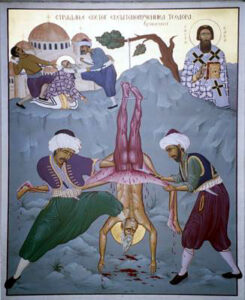
Il martirio di san Teodoro Nestorović, vescovo ortodosso serbo 1594