
La guerra si vede nei corpi, nei nomi, nelle gerarchie che saltano.
Ma si capisce nei dettagli.
L’eliminazione mirata dei vertici, la decapitazione simbolica del potere, l’esposizione pubblica della vulnerabilità dell’avversario: sono gesti antichi, profondamente romani nella loro logica. Allora era la Persia a umiliare l’Imperatore; oggi è l’Occidente a colpire, con una precisione quasi clinica, i nodi del sistema iraniano. Restano vuoti, restano nomi cancellati, uomini che fino al giorno prima sembravano intoccabili.
Poi il silenzio. E subito dopo la comunicazione.
C’è un dettaglio che sfugge facilmente, ma che dice molto del nostro tempo. Il nemico scrive su X. La Repubblica Islamica annuncia i suoi morti utilizzando una piattaforma americana. Server americani, linguaggio globale, algoritmi addestrati altrove. Non è ironia. È struttura.
La Repubblica Islamica definisce gli Stati Uniti il Grande Satana, ma utilizza i suoi strumenti per parlare al mondo. Vende petrolio — direttamente o indirettamente — in dollari, la valuta del nemico. Quando i figli dei gerarchi crescono, non li mandi a Qom — li mandi a Londra, a Parigi, a Toronto, dove con i petrodollari comprano case e futuro. Quando si ammalano, non li curi a Teheran — li porti dove la medicina funziona davvero.
E intanto continua a gridare morte all’America. È una forma di schizofrenia perfettamente funzionale. Ricorda la dinamica di una ribellione adolescenziale. Il figlio contesta il padre, ne rifiuta l’autorità, lo accusa, lo provoca. Sbattendo porte, certo. Ma restando in casa. Usando il suo Wi-Fi. Mangiando nel suo frigorifero. La ribellione è autentica. Ma non è ancora libertà. E a volte questa ambivalenza affiora nei dettagli più piccoli, quelli che nessuno dovrebbe notare — e che invece restano impressi.
Una fotografia: Ali Larijani, volto serio, uomo di sistema, con un paio di Ray-Ban scure sul viso. Perfette. Pulite. Globali. Potrebbero essere a Teheran come a Milano, a New York, a Phuket. Non è un cedimento. È peggio. È interiorizzazione. Il rifiuto che si esprime attraverso ciò che rifiuta. L’identità che si costruisce con materiali altrui. Come ogni adolescenza, questa fase mescola negazione e imitazione. Rabbia e attrazione. Rottura dichiarata e continuità nascosta. La differenza è che qui nessuno cresce davvero. Perché il sistema globale è uno solo. Non ci sono più due case. Non c’è un “fuori” dove trasferirsi. E quando provi a uscire davvero, scopri che stai solo cambiando stanza.
La guerra continua. Si colpisce, si elimina, si manda un messaggio. Tutto calibrato, quasi elegante. Ma senza mai arrivare al punto di rottura reale. Nessuno taglia il cavo. Perché quel cavo — invisibile, finanziario, tecnologico, culturale — tiene in piedi tutto. Anche chi lo maledice ogni giorno. E allora la verità è più semplice, e meno eroica. Non è una guerra contro il padre. È una ribellione che non può permettersi di vincere.
19 marzo
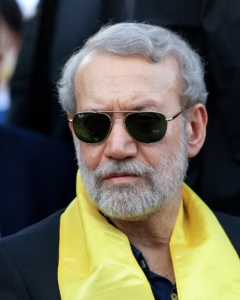
Ali Larijani
War is seen in bodies, in names, in hierarchies collapsing.
But it is understood in the details. The targeted elimination of leadership, the symbolic decapitation of power, the public exposure of an adversary’s vulnerability: these are ancient gestures, deeply Roman in their logic. Then it was Persia humiliating the Emperor; today it is the West striking, with almost clinical precision, at the nodes of the Iranian system. What remains are voids, erased names, men who until the day before seemed untouchable.
Then silence. And immediately after, communication. There is a detail that is easy to miss, yet says much about our time. The enemy writes on X. The Islamic Republic announces its dead on an American platform. American servers, global language, algorithms trained elsewhere. This is not irony. It is structure.
The Islamic Republic calls the United States the Great Satan, yet uses its instruments to speak to the world. It sells oil — directly or indirectly — in dollars, the enemy’s currency. When the sons of the regime’s men grow up, you do not send them to Qom — you send them to London, Paris, Toronto, where with petrodollars they buy houses and a future. When they fall ill, they are not treated in Tehran — they are taken where medicine actually works. And still, the chant remains: death to America. It is a form of perfectly functional schizophrenia. It resembles the logic of adolescent rebellion.
The son challenges the father, rejects his authority, accuses him, provokes him. Slamming doors, certainly. But remaining inside the house. Using his Wi-Fi. Eating from his refrigerator. The rebellion is real. But it is not yet freedom. And sometimes this ambivalence emerges in the smallest details — the ones no one is supposed to notice, and yet linger.
A photograph: Ali Larijani, a man of the system, wearing a pair of dark Ray-Ban sunglasses. Perfect. Clean. Global. He could be in Tehran, Milan, New York, Phuket — it makes no difference. This is not concession. It is something else. It is internalization. Rejection expressed through what is rejected. Identity built from borrowed materials. Like every adolescence, this phase mixes denial and imitation. Anger and attraction. Declared rupture and hidden continuity.
The difference is that here, no one really grows up. Because the global system is one. There is no second house. There is no “outside” to move to. And when you try to leave, you realize you are only changing rooms. And so the war continues. Strikes are made, men are removed, messages are sent. Everything calibrated, almost elegant. But never reaching the point of real rupture. No one cuts the cable. Because that cable — invisible, financial, technological, cultural — sustains everything. Even those who curse it every day. And so the truth is simpler, and less heroic. This is not a war against the father. It is a rebellion that cannot afford to win.